Strings, Guitar, & Harp
A Creative Approach to String Education
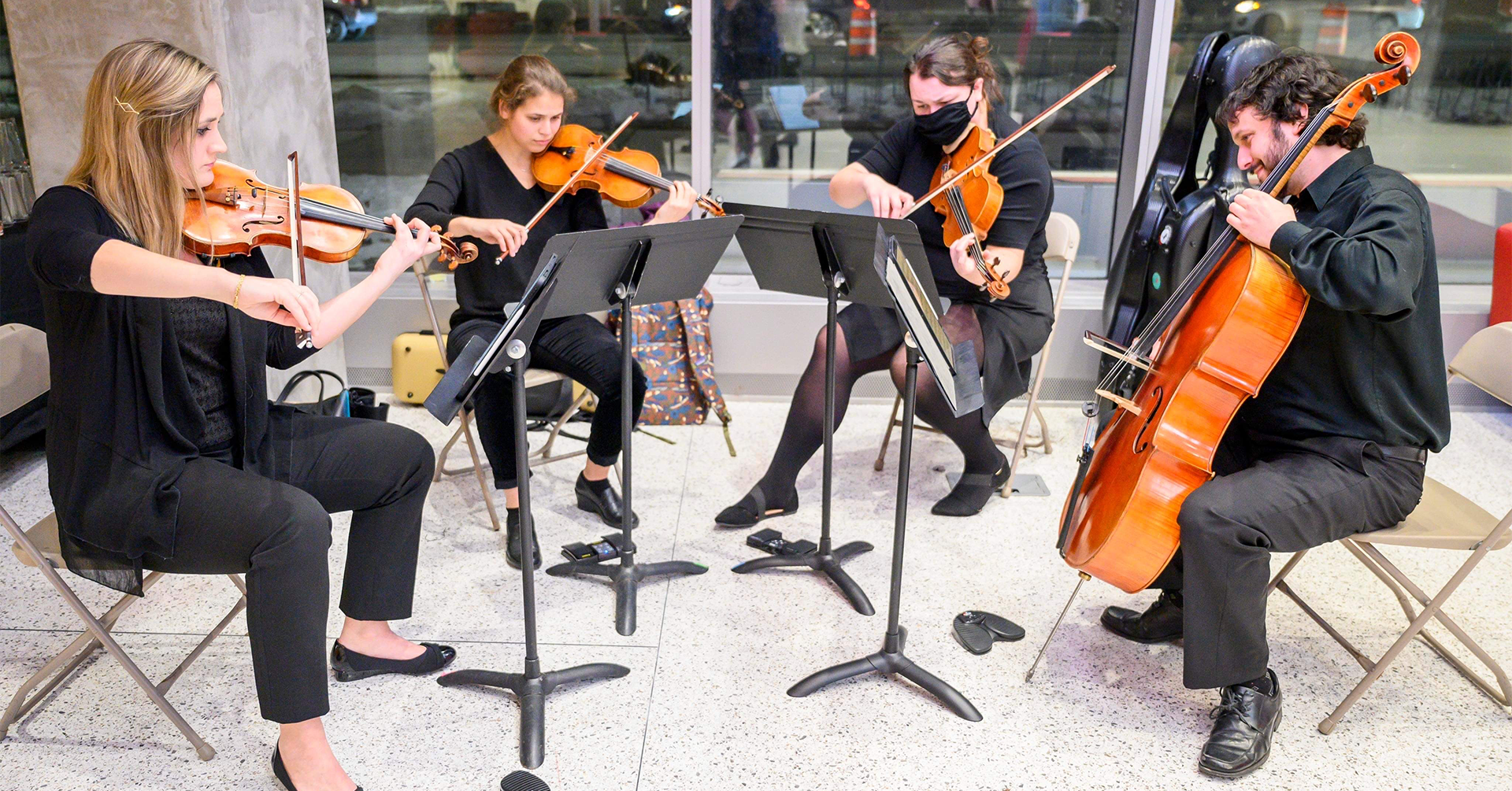
String graduates are regularly accepted on scholarship at top conservatory graduate programs. Many have won positions in major orchestras, are members of internationally known string quartets, have professorships in major universities, and are laureates from top international competitions.
String area faculty includes internationally active performers who are acclaimed soloists, renowned chamber and orchestral musicians, and leading pedagogues. The String area offers coached ensembles who perform each semester, including the Perlman Piano Trio and Rabin Quartet.
All string students receive weekly lessons and master classes with their major professor, with frequent guest artist master classes also available. Recent guests include Pinchas Zuckerman, Rachel Barton, Nobuko Imai, Samuel Rhodes, Mark Kosower, Leon Fleisher, and Charles Neidich.
Related Resources
Degrees offered
Click here for Undergraduate degree options (Bachelor of Arts/Music/Science)
Undergraduate Admission Requirements
Please see information on the School of Music application process.
Please click here for Strings audition procedures for 2025-26 application cycle.
Audition repertoire
- Your audition should include two or three contrasting movements, or compositions, such as a slow and fast movement, representing the candidate’s technical and musical ability. The candidate is strongly encouraged to include in these choices a movement of a standard concerto, and (with the exception of bassists) a movement of solo unaccompanied Bach.
Guitar
- Two movements or compositions in contrasting character or style, such as a fast and slow movement of a Sor Etude, Nos. 11-20 (Segovia edition)
- A movement of a Bach Suite (or the equivalent)
Harp
Perform an audition, up to 10 minutes, on your major instrument for the area faculty. Your audition should include:
- Two solos (applicant’s choice) in contrasting styles demonstrating technical and interpretive abilities. Harp applicants are encouraged to perform solos from memory.
- An orchestral excerpt or cadenza from the standard repertoire.
The following pathways are offered for Master’s level study:
- Strings (Cello, Double Bass, Viola, Violin)
- Guitar
- Harp
Admissions
Please see the Graduate Admissions page for detailed information on application requirements. Be sure to review the “Graduate Application Guide” as well as the additional information for the Strings area.
Degree Requirements
For detailed information on coursework, exams, recitals, etc., please visit the Graduate Advising KnowledgeBase. Be sure to check out the Strings degree worksheets for specifics.
The following pathways are offered for DMA study:
- Strings (Cello, Double Bass, Viola, Violin)
- Guitar
Admissions
Please see the Graduate Admissions page for detailed information on application requirements. Be sure to review the “Graduate Application Guide” as well as the additional information for the Strings area.
Degree Requirements
For detailed information on coursework, exams, recitals, etc., please visit the Graduate Advising KnowledgeBase. Be sure to check out the Strings degree worksheet for specifics as well as a 3-year timeline and explanation of doctoral milestones.
Doctoral Minor – Required for all Doctoral programs
The purpose of the doctoral minor is to add breadth and depth to the D.M.A or Ph.D degree. To insure coherence a minor program must be approved by the appropriate department, a student’s advisor, and the Director of Graduate Studies, and must include courses at the 300-level or above. Typically, a minor requires 12 credits of work.
Students have a variety of options, including completing an internal minor within the School of Music (e.g., a D.M.A. conducting student who minors in ethnomusicology or a Ph.D. in music theory who minors in clarinet performance), completing a minor in a department outside the School of Music (e.g., a D.M.A. in horn performance who minors in Women’s Studies or a Ph.D. in ethnomusicology who minors in East Asian studies).
Students may, in consultation with the Director of Graduate Studies, devise a distributed minor that brings together courses from a variety of departments around a particular topic or area of interest. For example, a D.M.A. student in voice devises a minor in vocal health that includes courses in communicative disorders, or a Ph.D. student in musicology devises a minor in Medieval History that includes courses in art history, history, and languages.