Jazz Ensembles
A wide variety of jazz ensembles
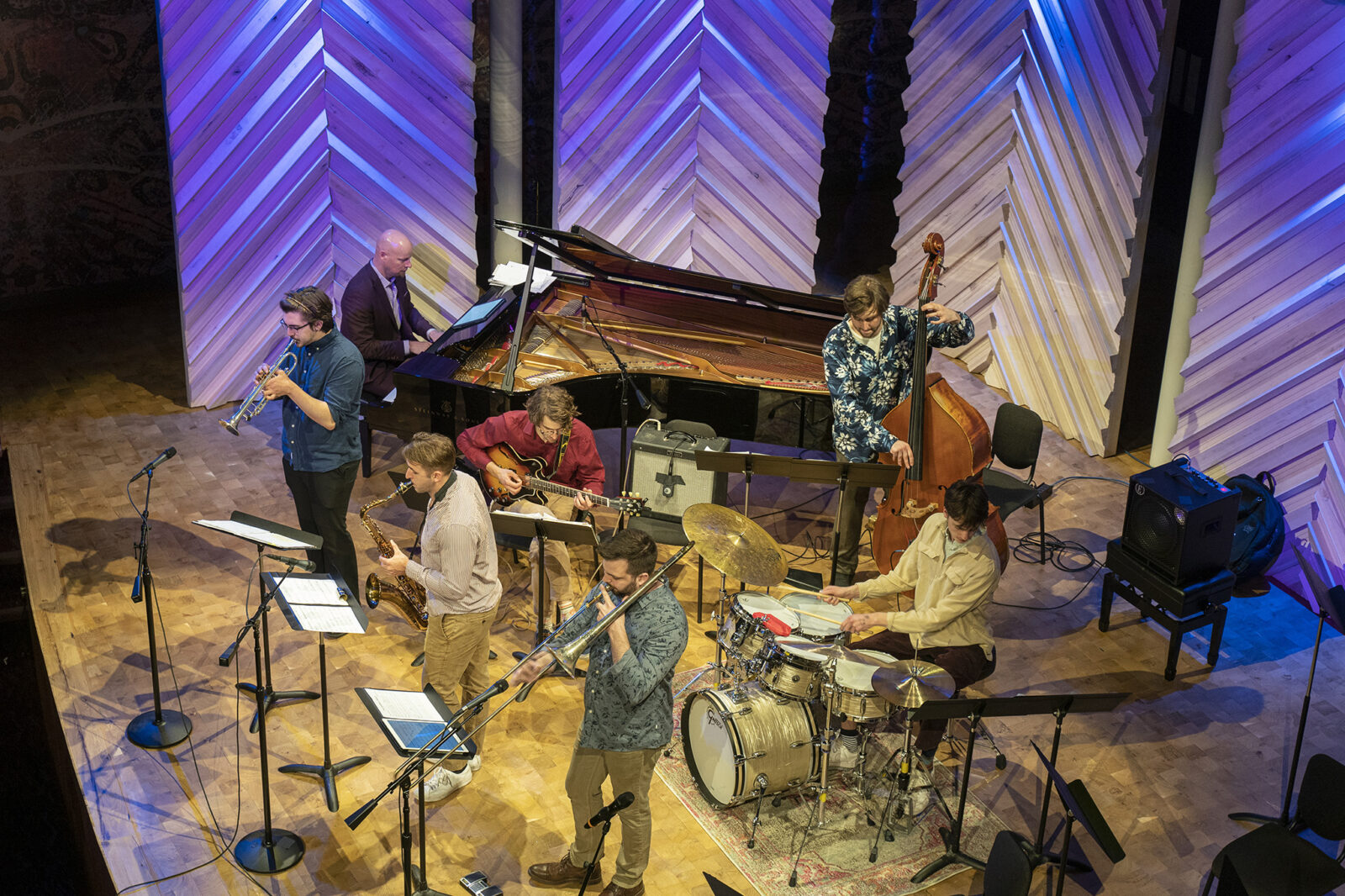
Our Jazz Studies program offers a wide variety of ensembles for undergraduate and graduate students to join, both music majors and non-music majors alike. Jazz students have opportunities to perform both on and off campus numerous times per year, in groups ranging from the traditional big band setting to small contemporary ensembles to Latin jazz-focused combos.
Nick Moran, director
Rehearsal Schedule: Thursday, 6 pm-8 pm, 1321 Humanities Building
Course Number: 660-262 (for undergraduate credit), 660-562 (for graduate credit); 1 credit.
Prerequisite: Audition required.
Description: A small jazz ensemble that covers a wide range of Afro-Cuban music, including son, son montuno, guaracha, mambo, bembe, danzón, guaguancó, cha-cha-chá, mozambique, rumba, and bolero. Students in the Afro-Cuban Jazz Ensemble work with the rhythmic concepts of clave in practical application, including improvisation and theoretical knowledge. The group consists of 2–4 frontline instruments (brass, woodwinds, or strings), 1–2 comping instruments (piano, guitar, vibraphone), bass, drums, and percussion.
Open to All Majors (Y/N): Yes, any UW–Madison student wishing to be considered for placement in the Afro-Cuban Jazz Ensemble may audition, regardless of degree path.
Johannes Wallmann, director
Rehearsal Schedule: Tuesdays, 3:30 pm-5:30 pm; 1321 Humanities Building
Course Number: 660-262 (for undergraduate credit), 660-562 (for graduate credit); 1 credit.
Prerequisite: Audition required.
Description: The Blue Note Ensemble consists of 2–3 frontline instruments (trumpets, trombones, saxophones, other woodwinds or high strings), and 1–2 comping instruments (piano, guitar, vibraphone), bass, and drums. It performs music from the post-bop jazz period of the 1950s and 1960s (such as the music of Horace Silver, Hank Mobley, Lee Morgan, Herbie Hancock, Joe Henderson, and Art Blakey). Each semester primarily focuses on the music of a single jazz artist.
Open to All Majors (Y/N): Yes, any UW–Madison student wishing to be considered for placement in the Blue Note Ensemble may audition, regardless of degree path.
Kathryn Schulmeister, director
Course Number: Music 262/562 (066), 1 credit
Prerequisite: Audition required.
Nick Moran, director
Rehearsal Schedule: Thursdays, 3:30 pm-5:30 pm, 1321 Humanities Building
Course Number: 660-262 (for undergraduate credit), 660-562 (for graduate credit); 1 credit.
Prerequisite: Audition required.
Description: The Contemporary Jazz Ensemble consists of 2–3 frontline instruments (trumpets, trombones, saxophones, other woodwinds or high strings), and 1–2 comping instruments (piano, guitar, vibraphone), bass, and drums. This small group performs contemporary, mainstream jazz repertoire from the last two decades (such as the music of Dave Douglas, Terence Blanchard, Kenny Wheeler, Chris Potter, David Binney, Dave Holland, and Brian Blade), as well as student compositions.
Open to All Majors (Y/N): Yes, any UW–Madison student wishing to be considered for placement in the Contemporary Jazz Ensemble may audition, regardless of degree path.
Aruṇ Lūthrā, director
Rehearsal Schedule: Tuesday, 6 pm-8 pm
Course Number: 660-262 (for undergraduate credit), 660-562 (for graduate credit); 1 credit.
Prerequisite: Audition required.
Description: A small jazz ensemble focused primarily on workshopping and performing student compositions.
Open to All Majors (Y/N): Yes, any UW–Madison student wishing to be considered for placement in the Jazz Composers Group may audition, regardless of degree path.
Aruṇ Lūthrā, director
Rehearsal Schedule: Mondays, 3:30-5:30 pm, 1321 Humanities Building
Course Number: 660-262 (for undergraduate credit), 660-562 (for graduate credit); 1 credit.
Prerequisite: Audition required.
Description: The Jazz Standards Ensemble performs music from the standard jazz repertoire. It consists of 2–3 frontline instruments (trumpets, trombones, saxophones, other woodwinds or high strings), and 1–2 comping instruments (piano, guitar, vibraphone), bass, and drums.
Open to All Majors (Y/N): Yes, any UW–Madison student wishing to be considered for placement in the Jazz Standards Ensemble may audition, regardless of degree path.
Mitchell Shiner, director
Rehearsal Schedule: Tuesdays, 6 pm-8 pm, 1321 Humanities Building
Course Number: 660-297; 1 credit.
Prerequisite: Audition required.
Students, please contact Mitchell Shiner at mshiner2@wisc.edu to ask about auditions for Fall 2026.
Description: Ensemble exploring a variety of musical styles through rehearsals and performance. Audition and instructor consent required for students enrolling for the first time. Explore musical styles shaped by social movements and by generational and cultural identity through rehearsals and performance. Styles to be covered, studied, and performed include, but are not limited to, Hip Hop, Reggae, Jazz, Rock, and Cumbia. Students are expected to become familiar with the styles introduced in class and their associated formal structures. Students will develop practical familiarity with the rhythmic concepts of each musical style, including improvisation and theoretical knowledge. Additionally, students are expected to sing and play a variety of acoustic and electronic instruments, and may be expected to perform music from memory. Finally, students may have the opportunity to arrange and/or compose tunes for this ensemble.
Open to All Majors (Y/N): Yes, any UW–Madison student wishing to be considered for placement in the Resistance Music Ensemble may audition, regardless of degree path. Open to all instruments and vocalists. Fulfills the “List B” (cultural breadth requirement) for music education majors.
Gabriel Wade, director
Rehearsal Schedule: Monday & Wednesday, 6 pm-8 pm, 1321 Humanities Building
Course Number: 660-262 (for undergraduate credit), 660-562 (for graduate credit); 1 credit.
Prerequisite: Audition required.
Description: The UW Jazz Orchestra includes 5 saxophones (2 alto, 2 tenor, 1 bari; flute and/or clarinet doubling experience preferred, but not required); 4 to 5 trumpets; 4 to 5 trombones; and piano, guitar, bass, drums. The ensemble workshops and performs music ranging from the classic big band repertoire to contemporary and cutting-edge concert jazz music by today’s leading jazz composers.
Open to All Majors (Y/N): Yes, any UW–Madison student wishing to be considered for placement in the UW Jazz Orchestra may audition, regardless of degree path.
Jazz Ensemble Auditions
Fall 2026 auditions are now closed. Jazz ensembles will for the mostly continue with the same fall roster into the spring semester, but there may be isolated openings to join an ensemble for the spring semester. If you are interested in joining a jazz ensemble for the spring semester, email Professor Wallmann at wallmann@wisc.edu to schedule an ad-hoc audition.
Audition details
Perform a work or works of your choosing (no longer than 5 minutes in length) that best exhibits your ability on your primary instrument. Please select a work that you feel most comfortable performing that showcases your proficiency on your instrument. As most of the music covered in this course is groove-based, you are encouraged to perform works that illustrate strong time-keeping abilities. No rubato works, please.
Students take a single audition, after which they are considered for placement in one of our six jazz ensembles. Auditions are open to music majors and non-majors on all instruments (jazz ensembles consist of roughly 50% music majors and 50% non-majors). Students must be enrolled in classes at UW–Madison. Once students have been assigned to an ensemble, they will receive a registration code and must then register for the corresponding section of the 1-credit class, MUS 262 (for undergraduate credit) or MUS 562 (for graduate credit).
The jazz ensembles are not ranked by experience or skill level. Upon a successful audition, students will be assigned a jazz ensemble based on multiple considerations, including the student’s schedule availability, instrument distribution, and available space within the ensembles, and other pedagogical decisions. Attempts are made to match similar skill and experience levels and factor in the student’s stated ensemble preference.
Students wishing to audition on more than one instrument should sign up for multiple audition time slots (one per instrument). Saxophonists who would like to be considered for multiple saxophone chairs (alto, tenor, baritone) should audition only on their first-choice saxophone but indicate their available doubles on their audition form.
There is a wide range of skill and experience levels represented in our jazz ensembles. However, rhythm section players (piano, guitar, vibraphone, bass, drums) should have prior jazz ensemble experience. Improvisation experience is required for most instruments, but there are some ensemble opportunities for brass and saxophone players who are novice improvisers.
Preparing for your audition
Students concerned about the sight-reading aspect of the audition can prepare for the audition by reading through transcribed jazz solos (available online) or reviewing previously played ensemble parts, and/or by reading through melodies and improvising over the changes of a variety of lead sheets from the various volumes of The Real Book (Hal Leonard), Jamey Aebersold Play-A-Longs, or other fake books.
Suggested melodies for sight-reading practice include both melodies that are usually performed as written (many jazz originals whose melodies are notated with very specific rhythms, especially bebop compositions such as pieces by Charlie Parker or Thelonious Monk) and melodies that require interpretive changes for an idiomatic jazz performance (most jazz standards, such as Broadway compositions by Cole Porter, George Gershwin, or Jerome Kern, which are usually notated in simplified forms in fake book lead sheets).
Students wishing to brush up on their ensemble improvisation are encouraged to prepare by informally playing jazz standards together with friends, to seek out jam session opportunities such as the Madison Jazz Jam and to practice along with recordings, the Jamey Aebersold Play-A-Longs, or the iReal Pro app.
A full drum set with cymbals, guitar amplifier, bass amplifier, and piano will be provided for the audition. Drummers may choose to bring their own cymbals and guitarists may choose to bring their own amplifiers. Upon successful audition and enrollment in a jazz ensemble course, instruments (woodwinds and brass instruments, basses) are available for rent from the School of Music. Unfortunately, we are unable to provide instruments in advance for students to prepare for their auditions.
Reading: Students will be asked to sight-read a jazz big band part together with piano accompaniment (provided). Focus is on jazz-appropriate phrasing, sight-reading accuracy, instrumental tone, and technical ability. Guitarists’ and pianists’ sight-reading piece will include comping over a given chord progression. Bassists’ sight-reading piece will include walking a bass line over a given chord progression. The level of difficulty of the sight-reading will be adjusted based on the auditioning student’s experience and reading ability. Students with limited reading skills who are otherwise experienced jazz players are still encouraged to audition, as sight-reading accuracy is only one of several consideration in ensemble placements.
Improvisation: Students will be asked to improvise on a standard chord progression. Novice improvisers who are not yet comfortable navigating chord changes can substitute improvising over a blues progression in the key of F (concert).
Drummers: Students auditioning on drum set will be asked to play a variety of jazz grooves at different tempos, including medium swing, ballad, two-feel, fast swing, bossa nova, samba, 3/4 jazz waltz, and others.
Audition:
In-person on Thursday, September 5, 6 pm-8 pm in Humanities 1321 (sign up here), or video audition to be submitted to njmoran@wisc.edu by Thursday, September 5 at 8 pm.
Perform a work or works (no longer than 5 minutes in length) that best exhibits your ability on your primary instrument. Please select a work that you feel most comfortable performing that showcases your proficiency on your instrument. As most of the music covered in this course is groove-based, you are encouraged to perform works that illustrate strong time-keeping abilities. No rubato works please.
Testimonial:
You must also submit a short paragraph describing your musical background as well as musical interests and experiences. This testimonial may include your music education, other instruments you are proficient in, as well as favorite musical experiences. You may also submit this info as a video testimonial (no longer than 3min) instead of a written paragraph or submit your testimonial orally at the in-person audition.