Brass
An all-encompassing brass education
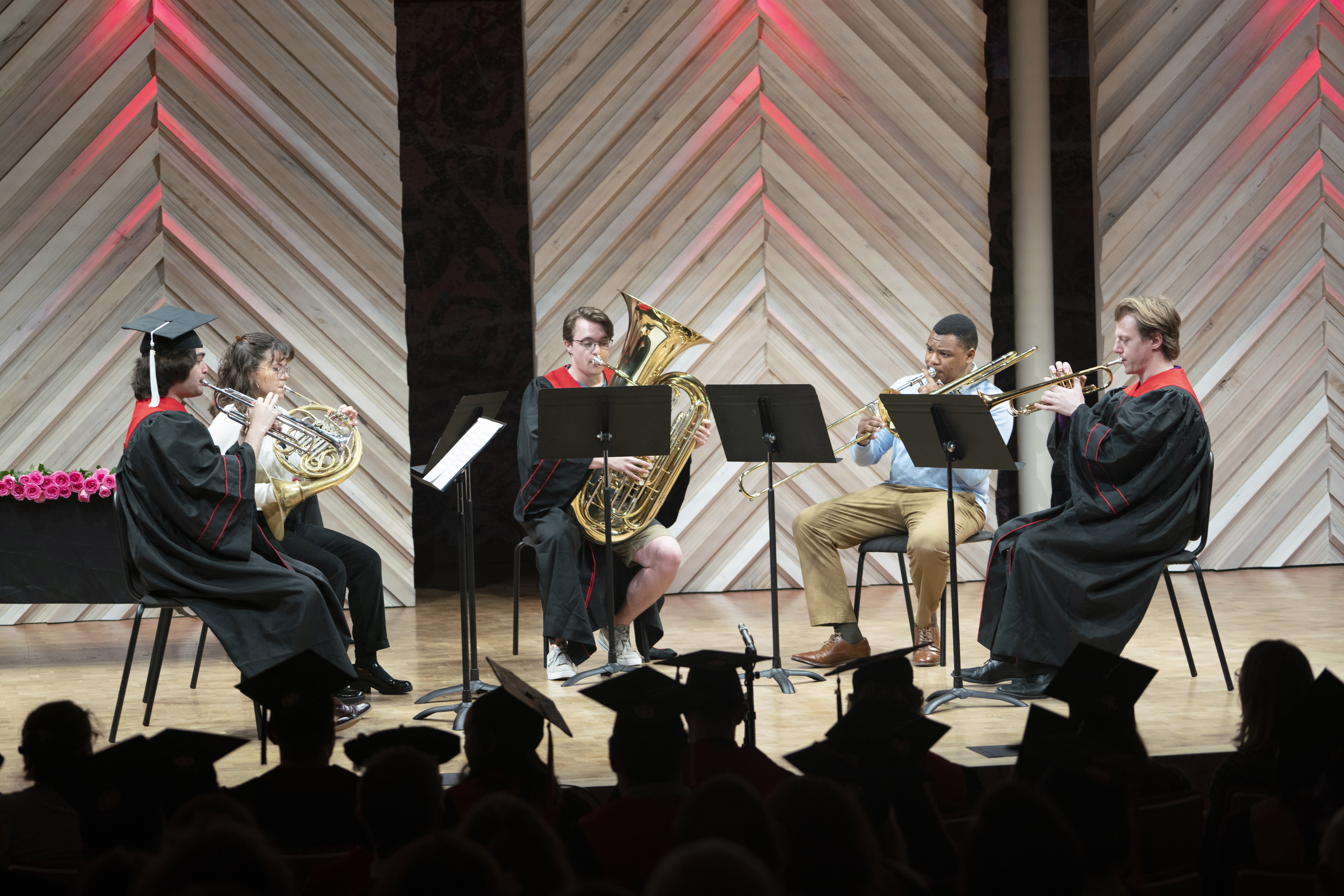
Brass area faculty members are active performers with professional expertise in chamber ensembles, orchestra, jazz, early music, and contemporary music. School of Music brass students benefit from this range of knowledge and receive an all-encompassing and well-rounded education focusing on musicianship. All brass majors work closely with faculty in weekly lessons and in master class.
Brass lessons are tailored to each student, fostering their particular educational interests, while maintaining the study of technique that allows students to become musically confident and expressive.
Each brass faculty member fully engages with students in their musical growth. Musical potential is expanded through the many opportunities and interactions with their professors. As a team of experts, the brass area provides mentorship, guidance, and a sense of connection for the thriving brass community in the School of Music.
Related Resources
Degrees offered
Click here for Undergraduate degree options (Bachelor of Arts/Music/Science)
Undergraduate Admission Requirements
See information on the School of Music application process.
Auditions for the 2026–27 school year will be held on campus. If an applicant is unable to attend an in-person audition, a remote audition via Zoom is also available.
Perform an audition, up to 20 minutes, on your major instrument (baritone-euphonium, horn, trombone, trumpet, or tuba) for the area faculty. It is not necessary to have an accompanist. The music performed should be as listed below:
- A composition from the solo repertoire of your instrument, including a movement of a concerto, sonata, or solo work or etude; or a standard or jazz composition with improvisation; or a transcription of a well-known artist/group from outside the Classical and Jazz genres
- Sight-reading of commensurate difficulty for all instruments
- Trumpet and Horn: may be asked to transpose a piece
- Trombone: may be asked to play tenor or alto clef
- Horn: may be asked to play bass clef
Admissions
Please see the Graduate Admissions page for detailed information on application requirements. Be sure to review the “Graduate Application Guide” as well as the additional information for the Brass area.
Degree Requirements
For detailed information on coursework, exams, recitals, etc., please visit the Graduate Advising KnowledgeBase. Be sure to check out the Brass degree worksheet for specifics.
Admissions
Please see the Graduate Admissions page for detailed information on application requirements. Be sure to review the “Graduate Application Guide” as well as the additional information for the Brass area.
Degree Requirements
For detailed information on coursework, exams, recitals, etc., please visit the Graduate Advising KnowledgeBase. Be sure to check out the Brass degree worksheet for specifics as well as a 3-year timeline and explanation of doctoral milestones.
Doctoral Minor – Required for all Doctoral programs
The purpose of the doctoral minor is to add breadth and depth to the DMA or PhD degree. To insure coherence a minor program must be approved by the appropriate department, a student’s advisor, and the Director of Graduate Studies, and must include courses at the 300-level or above. Typically, a minor requires 12 credits of work.
Students have a variety of options, including completing an internal minor within the School of Music (e.g., a D.M.A. conducting student who minors in ethnomusicology or a Ph.D. in music theory who minors in clarinet performance), completing a minor in a department outside the School of Music (e.g., a D.M.A. in horn performance who minors in Women’s Studies or a Ph.D. in ethnomusicology who minors in East Asian studies).
Students may, in consultation with the Director of Graduate Studies, devise a distributed minor that brings together courses from a variety of departments around a particular topic or area of interest. For example, a D.M.A. student in voice devises a minor in vocal health that includes courses in communicative disorders, or a Ph.D. student in musicology devises a minor in Medieval History that includes courses in art history, history, and languages.
Faculty
Brass ensembles
We offer instrument-specific brass chamber ensembles that rehearse and perform regularly.
The Wisconsin Trumpet Ensemble is directed by Jean Laurenz. Participation in the trumpet ensemble is intended to increase ensemble skills for each performer. It presents an opportunity for the study of trumpet specific repertoire. Wisconsin Trumpet Ensemble programming has been augmented by guest collaborative musicians performing on percussion, organ, and bass trumpets. Each year, new repertoire is introduced so that students gain an understanding of concert programming for trumpets over the span of their studies.
The ensemble is made up of trumpet undergraduate and graduate music majors and rehearses during the weekly master class time in the first half of the spring semester. The class focuses on all aspects of trumpet performance. Grad students are encouraged to accept leadership roles in the choice of repertoire, provide mentorship in rehearsals, and leadership in concert and competition venues.
The trumpet ensemble music spans the Baroque era to the most recent of contemporary compositions. Students have contributed arrangements to the Wisconsin Trumpet Ensemble library. Students have the opportunity to conduct, too. As well as performing on campus, the Wisconsin Trumpet Ensemble has given outreach concerts at area churches, senior centers as well as travelling to other state schools of music and to compete at the National Trumpet Competition.
Past trumpet ensemble members have gone on to teach at the public school and college level, serve in military bands, and perform in orchestras and brass quintets. A recent grad from the Wisconsin Trumpet Ensemble has served on the judge’s panel for trumpet ensemble for the National Trumpet Competition.
The UW–Madison Low Brass Ensemble is a combination of Trombone Choir and Tuba/Euphonium Ensemble and is co-directed by Mark Hetzler and Tom Curry. The ensemble rehearses on a weekly basis and performs in concert at least once each semester, as both a large Low Brass Ensemble and two related groups, the Trombone Choir and the Tuba/Euphonium Ensemble.
The group plays original compositions, transcriptions and arrangements of all kinds of music. This ensemble is open to any UW–Madison student who passes a live audition. The group also provides a wonderful opportunity for low brass players to double: trombonists who wish to get more time on the euphonium, or tuba and euphonium players who want to play tenor or bass trombone.
The Tuba/Euphonium Ensemble has been an important element of the UW low brass program for more than two decades. Made up of undergraduate and graduate music majors and accomplished non-majors, the ensemble rehearses weekly, performs a major concert each semester, and performs additional campus, school and community concerts on a regular basis, locally and around Wisconsin. The ensemble functions both as a choir of 12-20 players and in smaller chamber groups of 4-5 performers. Their repertoire consists of original compositions as well as arrangements and transcriptions of music from all periods, including jazz and popular works. Members of the group are encouraged to contribute as writers, and student compositions and arrangements are regularly included in the ensemble’s repertoire.
The ensemble has been featured at International Tuba-Euphonium Conferences (ITECs) in Chicago, Minneapolis, Regina, Saskatchewan and Greensboro, North Carolina. They have also performed twice at the annual U.S. Army Band Tuba-Euphonium Conference in Washington DC. Quartets that have formed as subgroups of the ensemble have won recognition in regional and international competitions.
The Sotto Voce Quartet, one of the world’s most outstanding professional brass chamber groups, began when the four members of the quartet were UW students and members of this ensemble. Over the years, many members of this ensemble have gone on to successful careers as professional performers, college and university professors and public school teachers across the country.
Every spring, the UW Horn Choir transforms itself as Twisted Metal, an all-horn rock band. Students arrange favorite songs, and the group adds a drummer to rock out in style.
Alumni
Alumni from the brass area can be found in major symphonies and professional chamber ensembles, on university faculties, as band directors in schools, as jazz artists and educators, and in careers in arts administration/entrepreneurship, composition, and recording.