Woodwinds
A highly collegial woodwind atmosphere
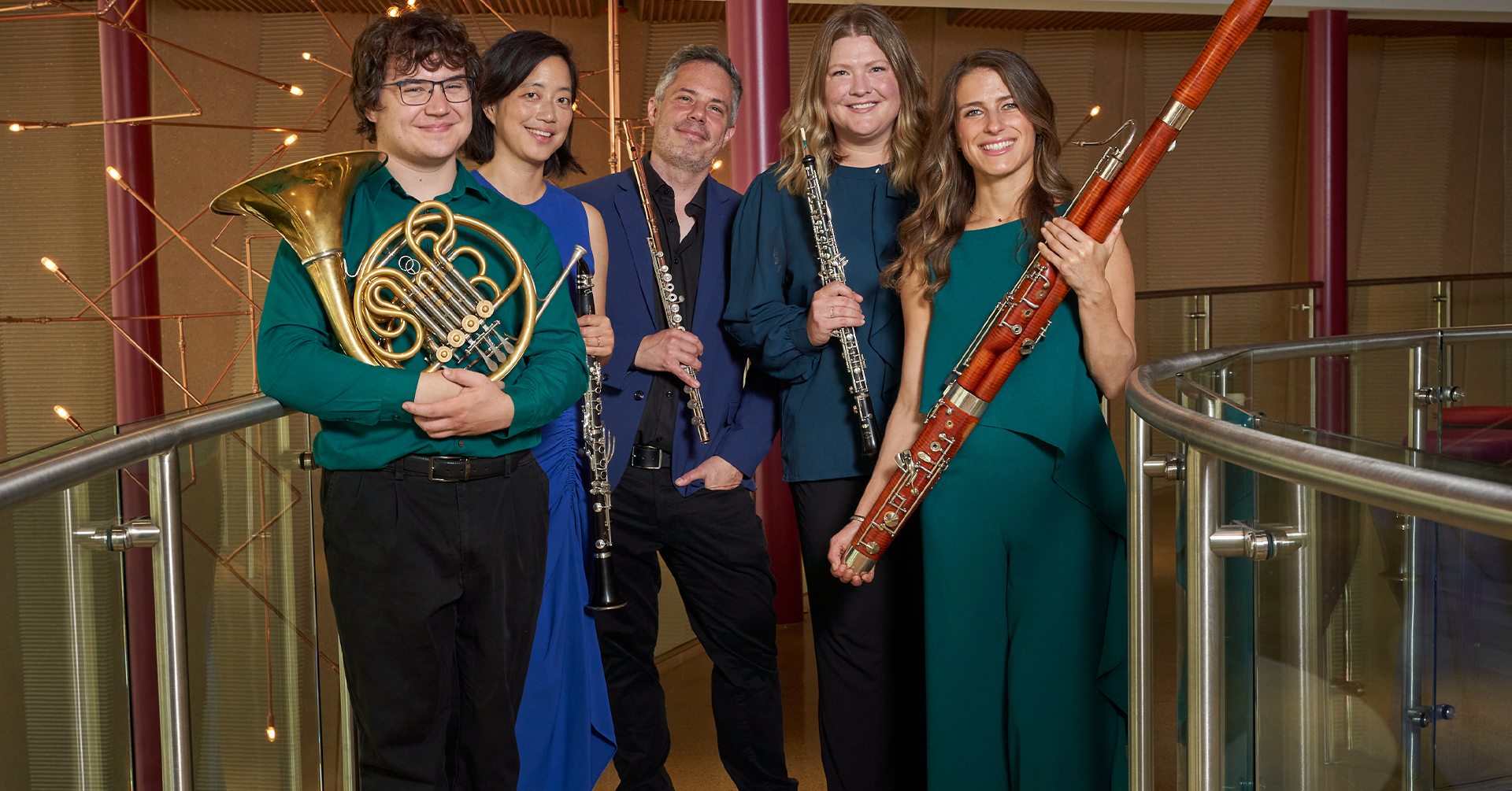
The Woodwind Area is a highly collegial atmosphere with a lot of give-and-take between studios. We frequently invite guest artists to inspire and teach our students, and we take a keen interest in the development of each individual student.
Our woodwind faculty is comprised of professors vitally connected with the national and international musical world. Our musical interests are broad and far-reaching, and include cutting-edge composition and extended techniques as well as the standard solo repertoire on which all of our playing is based. All of our faculty members have advanced degrees from high-ranking music schools in the United States and Europe, and are extremely active in the field of research, teaching, and performing.
We are committed to student success and to helping each other’s students. Many of the woodwind professors teach small ensembles each semester, and often coach each other’s students on special projects.
Related Resources
Degrees offered
Click here for Undergraduate degree options (Bachelor of Arts/Music/Science)
Admission Requirements
See information on the School of Music application process.
Click here for Woodwinds audition procedures for 2026-27 application cycle.
Bassoon
Bassoon applicants should prepare the following:
- Applicants should prepare any solo (such as a Class A music contest selection), or one movement from a standard sonata or concerto for the instrument. Audition should demonstrate tone, technical ability, and familiarity with major and harmonic minor scales and arpeggios up to 4flats, 4 sharps. Two octaves.
Oboe
Oboe applicants should prepare the following:
- One etude selected from the Barret Oboe Method or Ferling 48 Famous Studies.
- One contrasting work for the oboe chosen from the standard or contemporary solo literature. If the selection is taken from a multi-movement sonata or concerto, applicants need only prepare one movement of the piece.
- All major scales, encompassing a minimum of 2 octaves, slurred (does not need to be included in your audition video).
Flute
Flute applicants should prepare the following:
- Two contrasting works for the flute chosen from the standard or contemporary solo literature. If the selection is taken from a multi-movement sonata or concerto, applicants need only prepare one movement of the piece.
- Scales: All major and harmonic minor keys. Two octaves.
Clarinet
Clarinet applicants should prepare the following:
- One etude selected from Rose 32 Etudes for Clarinet.
- One contrasting work for clarinet chosen from the standard solo literature. If the selection is taken from a multi-movement sonata or concerto, applicants need only prepare one movement of the piece. Works written for A clarinet, should be performed on A clarinet.
- All major scales, minimum 2 octaves (does not need to be included in your audition video).
- Clarinet players who want to audition on bass clarinet must also audition on B-flat clarinet.
Saxophone
Saxophone applicants should prepare the following:
- All major scales. Full range, slurred.
- Two contrasting movements/pieces from the standard saxophone literature or a contest solo. Examples of appropriate repertoire include sonatas by Creston and Heiden, Tableaux de Provence by Paule Maurice, Romance by William Grant Still, and Improvisation et Caprice by Eugene Bozza. Transcriptions, such as those by Eccles, Saint-Saëns, and Schumann, are also acceptable. Applicants should demonstrate both technical and lyrical playing.
Admissions
Please see the Graduate Admissions page for detailed information on application requirements. Be sure to review the “Graduate Application Guide” as well as the additional information for the Woodwinds area.
Degree Requirements
For detailed information on coursework, exams, recitals, etc., please visit the Graduate Advising KnowledgeBase. Be sure to check out the Woodwinds degree worksheet for specifics.
Admissions
Please see the Graduate Admissions page for detailed information on application requirements. Be sure to review the “Graduate Application Guide” as well as the additional information for the Woodwinds area.
Degree Requirements
For detailed information on coursework, exams, recitals, etc., please visit the Graduate Advising KnowledgeBase. Be sure to check out the Woodwinds degree worksheet for specifics as well as a 3-year timeline and explanation of doctoral milestones.
Doctoral Minor – Required for all Doctoral programs
The purpose of the doctoral minor is to add breadth and depth to the D.M.A or Ph.D degree. To insure coherence a minor program must be approved by the appropriate department, a student’s advisor, and the Director of Graduate Studies, and must include courses at the 300-level or above. Typically, a minor requires 12 credits of work.
Students have a variety of options, including completing an internal minor within the School of Music (e.g., a D.M.A. conducting student who minors in ethnomusicology or a Ph.D. in music theory who minors in clarinet performance), completing a minor in a department outside the School of Music (e.g., a D.M.A. in horn performance who minors in Women’s Studies or a Ph.D. in ethnomusicology who minors in East Asian studies).
Students may, in consultation with the Director of Graduate Studies, devise a distributed minor that brings together courses from a variety of departments around a particular topic or area of interest. For example, a D.M.A. student in voice devises a minor in vocal health that includes courses in communicative disorders, or a Ph.D. student in musicology devises a minor in Medieval History that includes courses in art history, history, and languages.