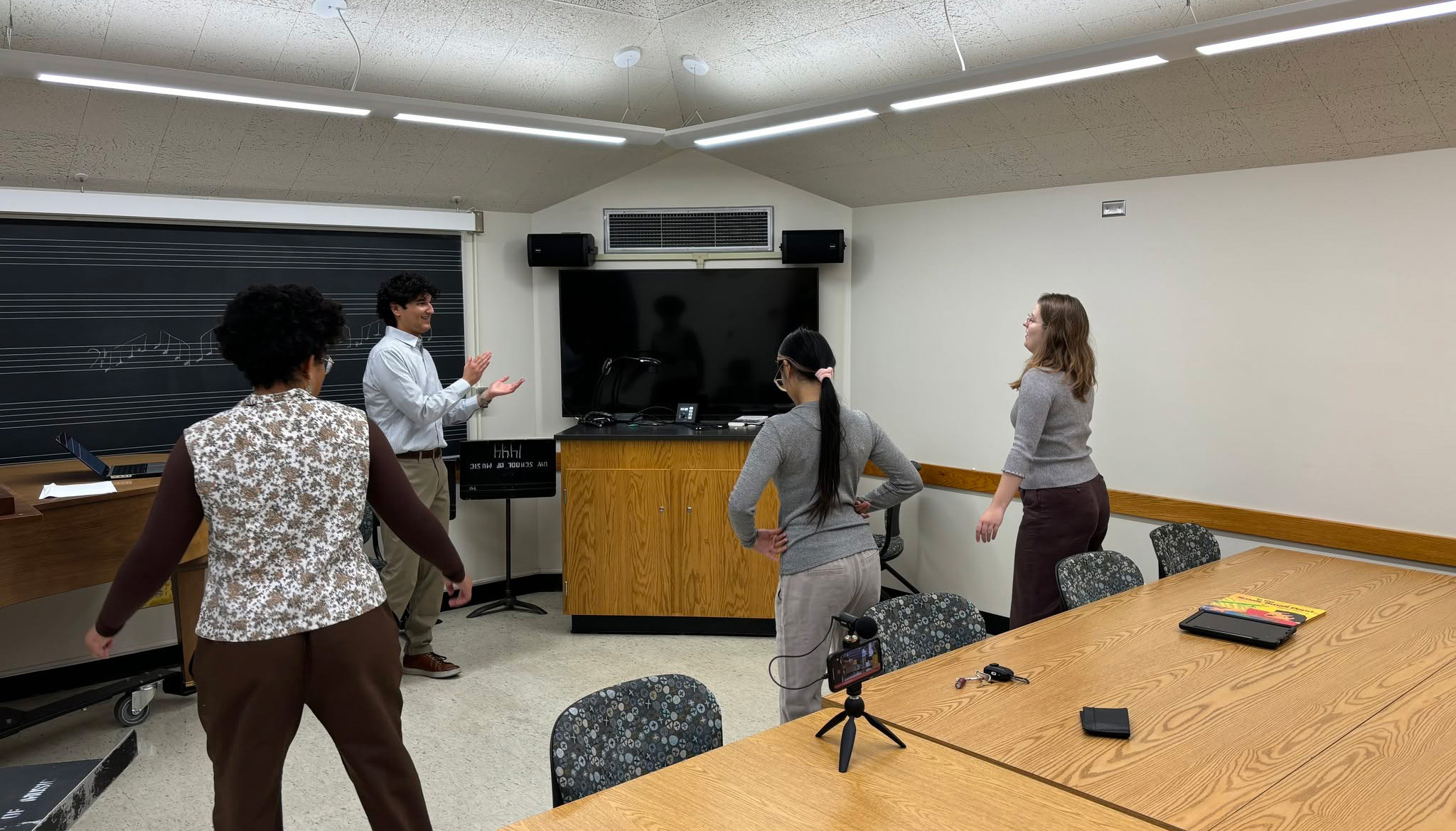
Music Education
Innovation in research paradigm and theory
Our Music Education area has been a center of leadership and creativity. It was among the first graduate programs in music education to embrace interpretive (qualitative) research, and our current faculty continues a tradition of innovation in research paradigm and theory, specializing in the emerging areas of revisionist history, ethnography, critical textual and discourse analysis, semiotics, iconography, policy studies, and action research.
Our Music Education program has been home to some of the finest music education scholars and teachers in the world. The following research areas are of particular interest to the faculty: Policy issues and their influence on music education; equity issues (i.e., issues concerning gender, race, social class, sexuality and ability/disability) in music education; revisionist historical analysis of music education in the United States; relationships between popular culture and music education; and philosophical questions in music education.
Related Resources
Degrees offered
The Bachelor of Music (B.M.) and Master of Music (M.M.) are offered through the School of Music. The Master of Science (M.S.) and Doctor of Philosophy (Ph.D.) are offered through the Department of Curriculum & Instruction.
Bachelor of Music in Music Education Degree Requirements
Admission Requirements
Please see information on the School of Music application process.
For admission, you will audition on your major instrument or voice for the appropriate faculty. Please visit Areas of Study for audition requirements for your instrument or voice.
The Master of Music in Music Education is offered through the School of Music.
Students who want to emphasize music content are advised to enroll in the M.M. program within the School of Music, while those who want to explore music education within the context of education at large are directed toward the M.S. which is housed in the Department of Curriculum & Instruction.
All students are encouraged to cross disciplines and to experience the rich educational opportunities provided in both schools, as well as those offered by other departments throughout the university.
Admissions
Applicants for the Master of Music degree must have an undergraduate degree in Music Education (closely related areas will be considered) and some experience as a professional educator in preK-12 and/or community music education settings, or else obtain the consent of the Music Education area faculty.
Please see the Graduate Admissions page for detailed information on application requirements. Be sure to review the “Graduate Application Guide” as well as the additional information for the Music Education area. Please note that no audition or interview is required.
Degree Requirements
For detailed information on coursework, exams, recitals, etc., please visit the Graduate Advising KnowledgeBase. Be sure to check out the Music Education degree worksheet for specifics.
Note: The Doctor of Philosophy (Ph.D.) degree with a concentration in music education is offered through the Department of Curriculum and Instruction.
Faculty
Music teaching certification/licensure resources
For questions regarding music teaching certification/licensure in the State of Wisconsin, please visit:
-
http://www.education.wisc.edu/soe/pk-12-education/pathways-to-licensure/educator-licensing
-
www.dpi.wi.gov/
-
WI DPI Fine Arts Education – Teacher Licensure & Certification
-
Educator Licensing Online (ELO) – Process
-
Pathways to Licensure
-
Out-of-State Licensure
-
FAQ: Education Licensing Online (ELO)
-
Contact DPI Support
-
Contact ELO Help Desk