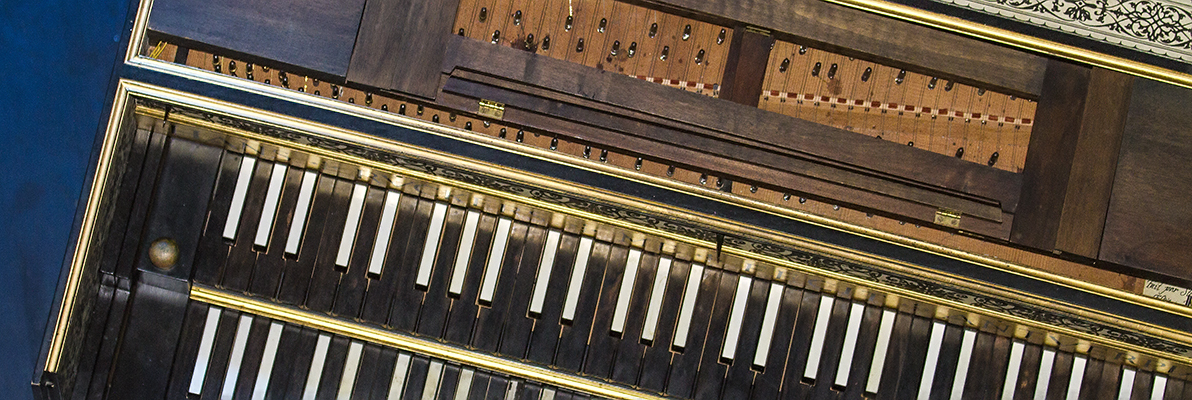
Keyboard
Join a supportive community of musical peers
Our keyboard program offers an array of innovative courses and experiences for young artists, where they strive for and attain the highest artistic ideals while developing a unique musical voice and professional skill set.
Situated within an enormous university with a fantastic variety of intellectual options, and within the beautiful and vibrant city of Madison, our keyboard students also find themselves part of an intimate and supportive community of musical peers, the high caliber of which will provide inspiration as well as encouragement.
With its outstanding instruction and its opportunities for practical experience, its friendly and inviting atmosphere, its varied possibilities for financial assistance at both undergraduate and graduate levels, and its record of students who successfully progress after graduation to the next stages of their careers, the keyboard program provides an environment par excellence for serious students who want to nurture their musical ambitions and cultivate their artistic spirits.
Related Resources
Degrees offered
Click here for Undergraduate degree options (Bachelor of Arts/Music/Science)
Undergraduate Admission Requirements
See information on the School of Music application process.
Click here for Keyboard audition procedures for 2026-27 application cycle.
Audition repertoire
Perform an audition, up to 20 minutes, on piano for the appropriate faculty. Your audition should include four memorized solos (except in the case of contemporary scores), major and harmonic minor scales (four octaves, hands together) and sight-reading at an intermediate level:
- A significant Baroque work such as a prelude and fugue (or several movements from a suite)
- A representative Classical work such as a movement from a sonata, set of variations, etc.
- Two additional pieces in contrasting styles
We encourage applicants to include works by historically marginalized, underrepresented, and living composers, or a work from your own cultural traditions. Show us who you are as an artist.
We offer three pathways in Master’s keyboard studies:
- Collaborative Piano
- Piano Performance
- Piano Performance & Pedagogy
Admissions
Please see the Graduate Admissions page for detailed information on application requirements. Be sure to review the “Graduate Application Guide” as well as the additional information for the Piano area.
Degree Requirements
For detailed information on coursework, exams, recitals, etc., please visit the Graduate Advising KnowledgeBase. Be sure to check out the Piano degree worksheets for specifics.
Additional information:
Collaborative Piano
The M.M. is designed to train pianists in the art of making music with others. This individualized program is tailored to the experience level of the student entering and involves extensive study of both instrumental and vocal repertoire. Study of diction, languages, coaching and ensemble techniques will be emphasized.
Piano Performance & Pedagogy
The M.M. combines high performance standards with diverse pedagogical offerings. Based on each candidate’s prior coursework and/or teaching experience, an individualized program is established to focus on areas of specialized research. Candidates gain practical teaching experience in private and group pre-college lessons, class piano for music majors and non-majors, and private lessons for advanced college students. Applicants with significant background in piano pedagogy and/or teaching experience may place out of required pedagogy courses and enroll in more advanced pedagogy coursework for a total of 10 credit hours in this area.
We offer three pathways in Doctoral keyboard studies:
- Collaborative Piano
- Piano Performance
- Piano Performance & Pedagogy
Admissions
Please see the Graduate Admissions page for detailed information on application requirements. Be sure to review the “Graduate Application Guide” as well as the additional information for the Piano area.
Degree Requirements
For detailed information on coursework, exams, recitals, etc., please visit the Graduate Advising KnowledgeBase. Be sure to check out the Piano degree worksheets for specifics as well as a 3-year timeline and explanation of doctoral milestones.
Additional information:
Collaborative Piano
The D.M.A. is designed to train and prepare pianists to perform, teach, and coach the broad range of repertoire pertinent to this field and to do so at the highest artistic level. This individualized program is tailored to the experience level of the student entering and involves extensive study of both instrumental and vocal repertoire. Study of diction, languages, coaching and ensemble techniques will be emphasized. Students may “lean” toward vocal or chamber music; thorough preparation in both areas is essential.
Piano Performance & Pedagogy
The D.M.A. is a selective program designed for candidates predominantly pursuing a professional career in college teaching and combines high performance standards with diverse pedagogical offerings. Based on each candidate’s prior coursework and/or teaching experience, an individualized program is established to focus on areas of specialized research. Candidates gain practical teaching experience in private and group pre-college lessons, class piano for music majors and non-majors, private lessons for advanced college students, and college piano classes team-taught with UW piano pedagogy faculty.
Doctoral Minor – Required for all Doctoral programs
The purpose of the doctoral minor is to add breadth and depth to the DMA or PhD degree. To insure coherence a minor program must be approved by the appropriate department, a student’s advisor, and the Director of Graduate Studies, and must include courses at the 300-level or above. Typically, a minor requires 12 credits of work.
Students have a variety of options, including completing an internal minor within the School of Music (e.g., a D.M.A. conducting student who minors in ethnomusicology or a Ph.D. in music theory who minors in clarinet performance), completing a minor in a department outside the School of Music (e.g., a D.M.A. in horn performance who minors in Women’s Studies or a Ph.D. in ethnomusicology who minors in East Asian studies).
Students may, in consultation with the Director of Graduate Studies, devise a distributed minor that brings together courses from a variety of departments around a particular topic or area of interest. For example, a D.M.A. student in voice devises a minor in vocal health that includes courses in communicative disorders, or a Ph.D. student in musicology devises a minor in Medieval History that includes courses in art history, history, and languages.
Instruction and professional advice from world-class faculty
Our world-class faculty offers instruction and professional advice to students that is grounded not only in extensive real-world performance experience, but in the maintenance of the highest intellectual standards. In addition to personalized lesson time, students meet weekly with their professors and peers for studio classes in which they perform for each other, acquiring both experience on-stage and valuable feedback. Other performance opportunities are abundant: regular departmental recitals; annual competitions (several of which provide monetary prizes along with opportunities to perform before larger audiences); chamber concerts with outstanding peers from other instrumental areas; special marathon events (past examples include concerts where the students collaborated to perform the complete Mozart piano sonatas and the complete Chopin mazurkas); and of course senior recitals and required graduate-level performances.